
How Pacific communities respond to environmental, social and economic change depends on more than technical solutions, with history, Indigenous knowledge, governance, livelihoods and collective action shaping how communities adapt and build resilience.
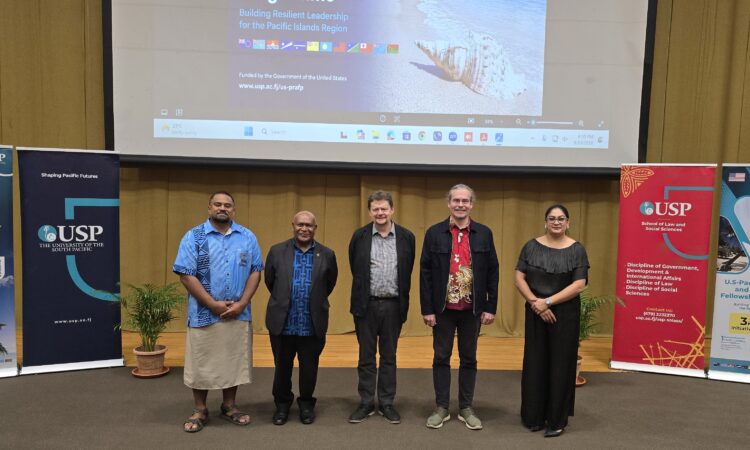
This was a key theme explored at a public seminar hosted by The University of the South Pacific (USP), titled Rural, Urban, and Policy Adaptation: Experiences from Papua New Guinea. The seminar was organised through the School of Law and Social Sciences and the U.S.–Pacific Resilience and Adaptation Fellowship Programme (U.S.–PRAFP).
Featured speakers included Dr Jamon Alex Halvaksz, Associate Professor of Anthropology at Georgetown University, and Alfred Tuikoro Tora, a U.S.–PRAFP PhD Scholar and PhD candidate in Psychology at USP.
Dr Halvaksz shared insights from his research on the political ecology of agriculture, conservation areas and gold mining along the Upper Bulolo River in Morobe Province, Papua New Guinea.
His wider research also examines experiences of environmental change and urban life in Port Moresby, Kavieng, Lae and Wau. He emphasised that adaptation should not be understood only as a technical response to environmental change.
It is also shaped by history, politics, livelihoods, relationships and the ways communities understand their place in the world.
Dr Halvaksz said the experiences of Papua New Guinean communities demonstrated the importance of everyday knowledge and collective responses.
The experiences of communities in Papua New Guinea remind us that resilience is grounded in everyday practices, local knowledge and the ability of people to respond collectively to change. By bringing rural and urban experiences into the same conversation, we can better understand the connections between environmental change, resource development, governance and people’s livelihoods.
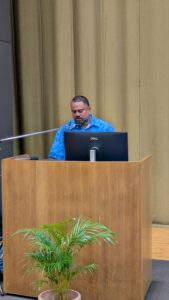
Tora explored the role of Indigenous Fijian knowledge in strengthening leadership, governance and resilience during his presentation, Indigenous Fijian Worldviews and Resilience in Community-Owned Businesses.
His presentation examined how Indigenous Fijian concepts influenced the way community-owned enterprises are led, governed and sustained.
Indigenous Fijian concepts such as vanua, lotu, veiwekani and talanoa provide important foundations for understanding leadership, cooperation and resilience within community-owned businesses.
Resilience is not only about recovering from challenges. It is also about maintaining relationships, strengthening collective responsibility and ensuring that development reflects the values of the community.
Community-owned enterprises have the potential to support sustainable development when decision-making is inclusive and grounded in Indigenous knowledge and local realities.
Tora
The seminar reinforced the value of bringing academic research, Indigenous knowledge and community experience into the same conversation.
Through initiatives such as the U.S.–PRAFP public seminar, USP continues to provide opportunities for regional knowledge-sharing and critical discussion on resilience, adaptation and sustainable development.