

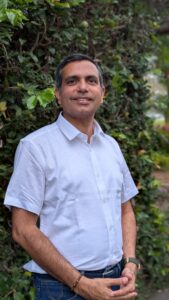
Ask Professor Utkal Mehta who has had the greatest influence on his career, and his answer is not a renowned academic, industry leader, or mentor. Instead, he points to his students.
Their curiosity, creativity, and determination continually motivate me to learn, innovate, and strive for excellence.
For more than 25 years, Professor Mehta has dedicated his career to teaching, research, and innovation in engineering. Helping students develop into engineers, researchers, and leaders has been one of the most rewarding parts of that journey.
His passion for engineering began during his school years, when he became fascinated by how machines and systems worked.
I often found myself taking things apart just to understand the principles behind them. At the same time, I enjoyed mathematics and how it could be used to explain real-world phenomena.
Utkal recalled.
That curiosity led him to study Electrical and Electronics Engineering at the Indian Institute of Technology (IIT), one of India’s leading engineering institutions.
He later spent more than three years as a Project Engineer with Comp Power USA, a research and product development company specialising in electromagnetic interference and electromagnetic compatibility (EMI/EMC), gaining valuable industry experience that continues to influence his work today.
Since joining The University of the South Pacific (USP) in 2012, Professor Mehta has built a distinguished career in teaching, research, and innovation. His research spans process control, robotics, automation, artificial intelligence, renewable energy, smart technologies, and applied fractional calculus.
Among his proudest achievements is establishing the Fractional Calculus Applications (FraCAL) Research Group, which has helped strengthen research capacity and foster collaboration among students and researchers.
I am driven by curiosity and the desire to find practical solutions to challenges facing Fiji and the Pacific region.
One project that reflects this vision is the Eye Braille Slate, an assistive learning tool designed to support children with visual impairments in learning Braille.
Developed with students, academics, and community partners, the innovation has been shared with schools and organisations supporting visually impaired learners and has received international recognition from the Institute of Electrical and Electronics Engineers (IEEE) for its contribution to humanitarian technology and inclusive education.
It also complements USP’s ongoing commitment to accessibility through initiatives such as the University’s Disability Resource Centre.
Some of the most rewarding projects are those that can make a direct difference to people. Assistive technology shows how engineering can help create more inclusive communities.
Professor Mehta
His work has earned numerous accolades, including the Vice-Chancellor’s Prize for Innovation in 2016 and 2018 for projects such as the Eye Braille Slate and Eye Cane, as well as the Faculty Prize for Excellence in Teaching in 2019.
Research and teaching remain closely connected in his work.
Every new discovery enriches my teaching, and every interaction with students inspires new ideas for research and innovation.
Professor Mehta currently serves as Dean of the Graduate School and leads the FraCAL Research Group. He was drawn to USP through its unique regional mission and the opportunity to contribute to development across Pacific Island countries through education, research, and innovation.
His commitment to advancing research was further strengthened through a Fulbright Scholarship in 2024-2025 at Fulbright University Vietnam, where he explored intellectual property and technology transfer.
After more than a decade at USP, however, Professor Mehta says his most memorable experiences remain the achievements of his students.
Whether it is watching a student publish their first research paper, complete a postgraduate degree, secure a professional engineering role, or represent the Pacific on the international stage, those moments stay with you.
Outside academia, he enjoys mentoring young people, participating in science, technology, engineering, and mathematics (STEM) outreach activities, travelling, and backyard gardening.
Now promoted to Professor of Electrical and Electronics Engineering, Professor Mehta views the achievement as an opportunity to continue contributing innovation across the Pacific.